Automate Trading Strategies Without Coding for Working Professionals
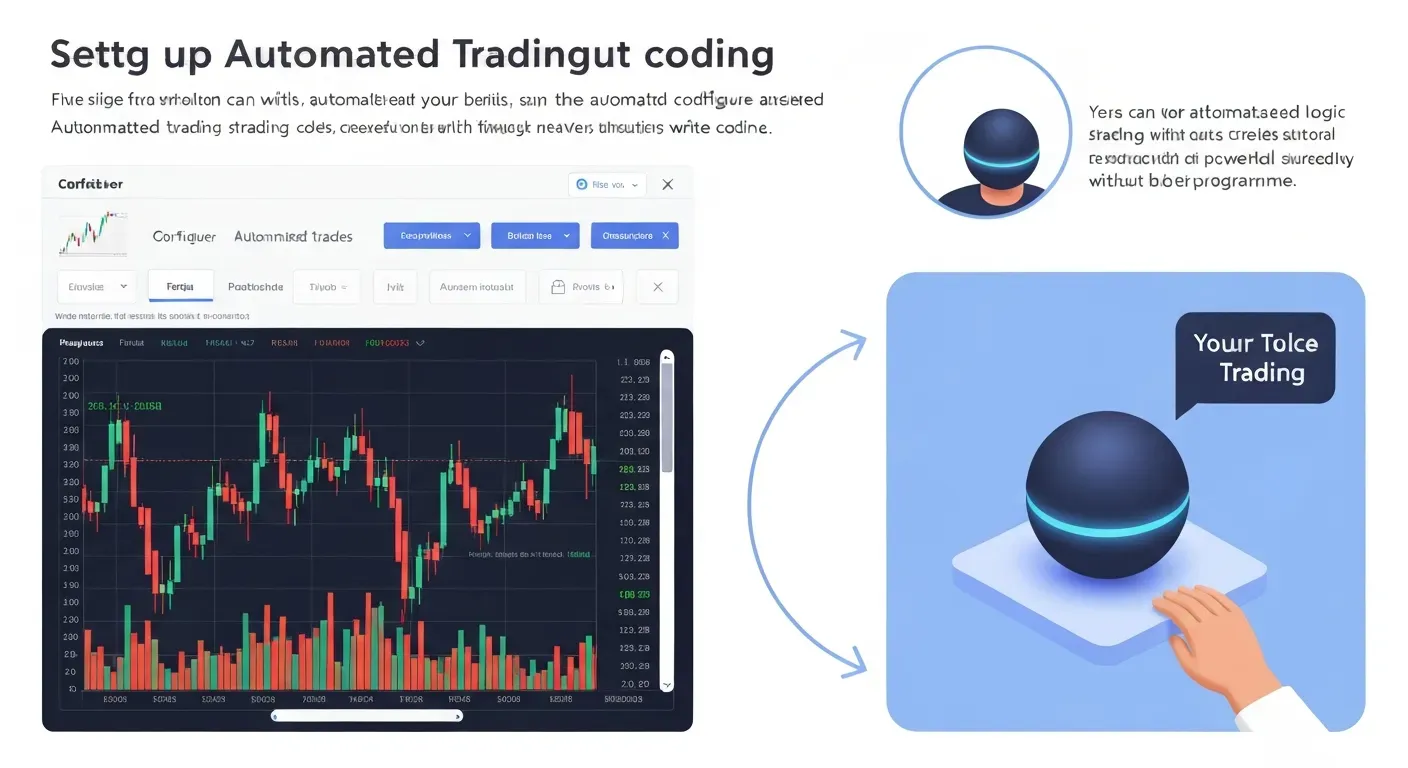 Are you a busy professional dreaming of a more passive approach to trading, one that doesn't demand constant attention? Imagine effortlessly capitalizing on market opportunities while you focus on your career. This guide is designed to bridge that gap, offering a revolutionary path to financial growth.
For those wondering how to automate trading without coding, automated trading for working professionals is no longer an unattainable goal. We'll explore how cutting-edge technology empowers you to build sophisticated trading systems without needing to write a single line of code.
Discover how AI and intuitive low-code platforms can transform your trading approach. You'll learn to design, test, and deploy powerful strategies using natural language and visual interfaces, setting you up as a strategic asset allocator for the dynamic markets of 2026 and beyond.
Top 5 Ways to Automate Trading Without Coding for Working Professionals in 2026
Working professionals can now automate trading without coding. Platforms in 2026 empower individuals to manage AI fund managers. This shift moves beyond manual trading, focusing on overseeing AI strategies and embracing the Agentic AI era. These tools democratize access to sophisticated automated trading for working professionals.
1. InvestGo: The AI Asset Management Platform
InvestGo positions itself as a programmable AI asset management platform. It targets Gen Z, developers, and quantitative enthusiasts. This platform shifts the paradigm from manual trading to managing AI fund managers, fully embracing the Agentic AI era. Users become asset allocators, not manual traders.
2. Strategy Canvas: Low-Code Strategy Orchestration
The Strategy Canvas is a low-code strategy builder, inspired by n8n's logic. It features a 'One Brain Architecture.' Each workflow ties to a single AI model, like DeepSeek-V3 or GPT-5, as the decision-making hub. Users define AI investment personas via natural language prompts. For example, "You are an aggressive right-side trader, only taking breakouts with strict stop-losses." Modular components such as 'Market Scanners' and 'Macro Data Streams' are drag-and-drop, feeding real-time data into the AI brain.
3. Virtual Exchange Node: Seamless Execution
The Virtual Exchange Node acts as an atomic executor, bridging AI decisions with the underlying ledger. The node offers a dual-mode switch. 'Backtest/Debug Mode' resets funds and history for prompt logic debugging. 'Live/Simulate Mode' maintains persistent fund status, supporting 24/7 continuous operation for real-time trading.
4. Prompt Engineering for Trading Personalities
Leveraging natural language prompts, users define the AI's investment personality. This allows granular control over trading behavior. Users can adopt aggressive, breakout-focused approaches with tight stop-losses, or choose a conservative, value-driven strategy. This prompt-based approach democratizes strategy creation, making automated trading for working professionals accessible.
5. White-Box Thinking Chain: Transparent AI Logic
InvestGo's proprietary 'White-Box Thinking Chain' technology provides transparency. It reveals the AI's reasoning process for every trade, demystifying the 'investment black box.' It transforms AI decision-making into a visual representation of logical steps. This clarity is crucial for users to understand and trust automated strategies.
These platforms enable how to automate trading without coding. Working professionals can now leverage advanced AI for efficient market participation.
Getting Started with Automated Trading in 2026
Automated trading offers working professionals a powerful way to engage with markets. Platforms like InvestGo are making it accessible, allowing users to automate trading without coding. This guide will help you navigate the initial steps.
Choosing the Right No-Code Platform
When selecting a no-code platform for automated trading in 2026, prioritize features like intuitive visual interfaces and robust AI model integration. Look for platforms that offer transparent logic visualization. InvestGo's platform, for instance, provides a low-code orchestration canvas.
This canvas allows users to define AI investment personas and strategies using natural language prompts. The platform's architecture centers around a "One Brain" approach, linking each workflow to a unique AI model as the decision-making hub.
Defining Your Trading Persona with Prompts
Crafting effective prompts is key to defining your AI's trading persona. Be specific about risk tolerance and market focus. For example, a prompt could state: "You are an aggressive right-side trader, focusing only on breakouts with strict stop-loss levels."
Experiment with different prompt structures to achieve the desired trading behavior. This allows for fine-tuning the AI's execution parameters.
Backtesting vs. Live Trading: What's the Difference?
Backtesting simulates your trading strategy on historical data without risking capital. This is crucial for debugging and refinement. Live trading, conversely, executes your strategy in real-time markets, requiring careful monitoring and risk management. InvestGo's platform offers both modes. The "Virtual Exchange Node" supports a "Backtest/Debug Mode" for logic testing and a "Live/Simulate Mode" for 24/7 operation.
| Mode | Purpose | Capital Risk | Data Scope |
|---|---|---|---|
| Backtesting | Strategy validation and debugging | None | Historical |
| Live/Simulate | Real-time execution and monitoring | Potential | Real-time/Live |
Understanding AI Decision-Making Transparency
Understanding the AI's decision-making process is vital for trust and optimization. InvestGo's 'White-Box Thinking Chain' technology provides visibility into why an AI makes specific trades.
This transparency enables you to identify potential biases or areas for improvement in your prompts. It transforms the "investment black box" into visualized "logic art."
Integrating Automated Trading into Your Workflow
For working professionals, seamless integration is paramount. Automated trading platforms should allow for minimal oversight, running 24/7. The goal is to free up your time while your AI manages trades based on your predefined strategies. This approach empowers individuals to automate trading without coding.
FAQ (Frequently Asked Questions)
Q1: Can I really automate trading without any coding knowledge?
A1: Yes, you can truly automate trading without coding knowledge. Platforms like InvestGo utilize a low-code approach. Users create trading strategies by interacting with natural language prompts and visual interfaces, making it possible to build sophisticated automated systems without writing a single line of code.
Q2: How does the 'White-Box Thinking Chain' work?
A2: The 'White-Box Thinking Chain' technology makes AI trading decisions transparent. It visualizes the logical steps and reasoning behind each buy or sell order. This demystifies the 'black box' of AI, showing users exactly why a particular trade was executed.
Q3: What are the risks of using AI for trading?
A3: The primary risks of using AI for trading include potential strategy failure due to unforeseen market conditions. Algorithmic errors, over-reliance on AI without oversight, and the inherent volatility of financial markets are also significant considerations. Vigilant monitoring remains essential.
Q4: Is InvestGo suitable for beginners in 2026?
A4: Yes, InvestGo is designed to be suitable for beginners in 2026. It offers a low-code canvas and transparent AI logic. This accessibility makes it practical even for those new to automated trading, lowering the barrier to entry.
Q5: How much capital do I need to start automated trading?
A5: The capital needed to start automated trading varies significantly. It depends on the platform, chosen trading instruments, and your risk tolerance. Some platforms offer simulated trading with no capital required. Live trading may require a minimum deposit.
| Feature | InvestGo (Simulated) | InvestGo (Live Trading) |
|---|---|---|
| Initial Capital | $0 | Varies (e.g., $100+) |
| Coding Knowledge | Not required | Not required |
| Risk Exposure | None | Market volatility |
| Learning Curve | Low | Moderate |
Conclusion
In 2026, the power to automate trading strategies without coding is a reality, making automated trading for working professionals more accessible than ever. Platforms like InvestGo unlock this potential, enabling you to shift from active management to strategic asset allocation effortlessly.
To begin your automated trading journey, explore low-code platforms and experiment with prompt engineering to define your AI trading persona. Crucially, always backtest your strategies thoroughly before committing to live trading.
Take control of your financial future today by embracing the ease of how to automate trading without coding. Start experimenting, refine your approach, and begin your automated trading adventure now!